

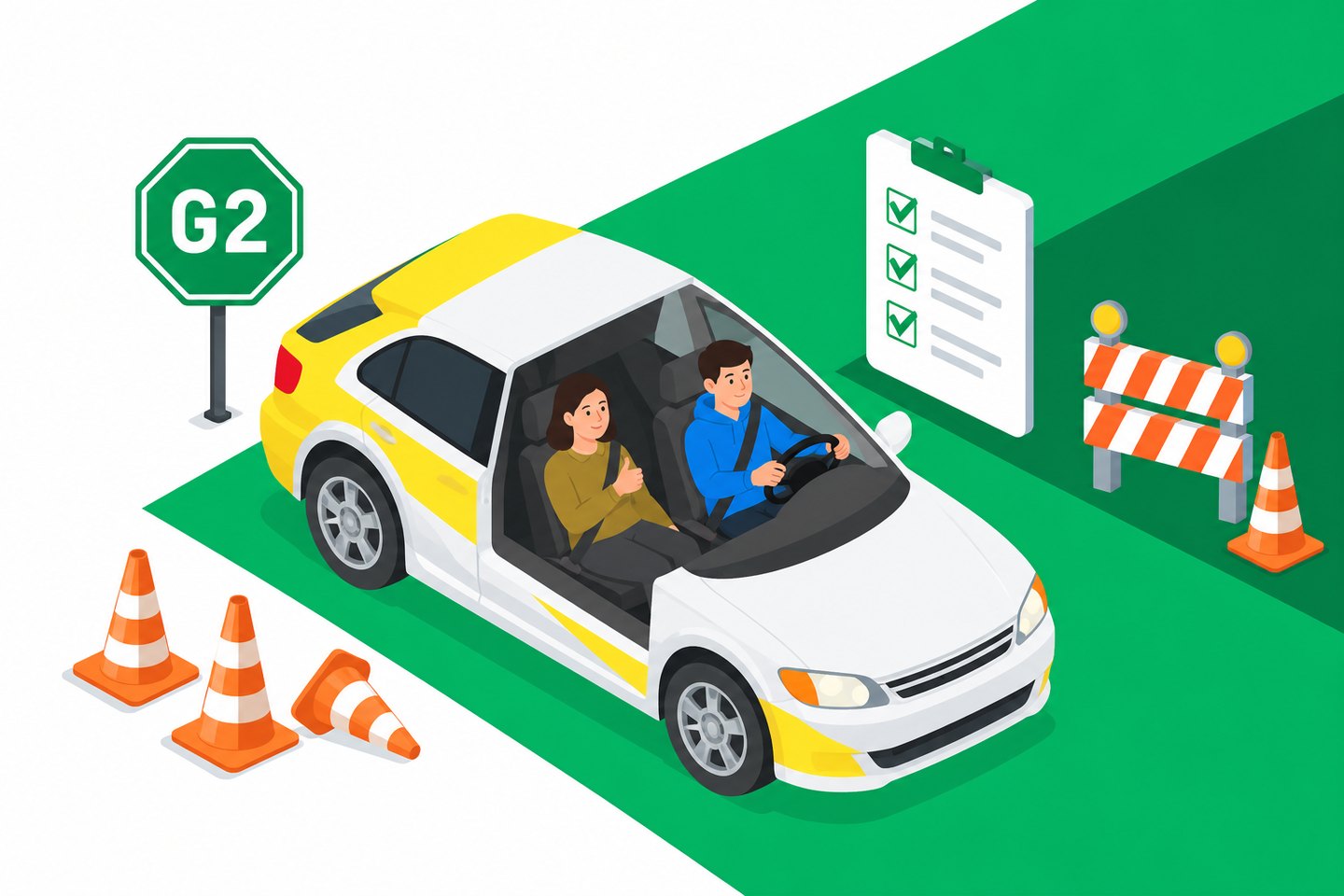
A Parent's Guide to Supporting a Teen Through G2 Driver Training
Parents can best support a teen through G2 driver training in Ontario by logging consistent supervised practice hours, staying calm and encouraging during drives, understanding the G1-to-G2 process so expectations stay realistic, and pairing home practice with a certified driving school. The months between a teen's G1 and G2 stages are when most real-world driving experience is built, and a parent's involvement has a direct effect on how confident and safe a new driver becomes. This guide walks through how much practice is enough, what to expect at each stage, and how to keep the experience calmer for everyone in the car.
Key takeaways
- There's no fixed legal minimum, but most new drivers benefit from regular, varied practice across many months, not a handful of weekend drives.
- Parents don't need to be certified instructors to supervise practice, they need patience, a calm voice, and a clear plan for each drive.
- A driving school and a parent aren't competing roles. One teaches technique and test-day structure; the other builds mileage and everyday confidence.
- Nerves before the G2 road test are normal for both the teen and the parent, preparation reduces them more than reassurance alone.
How Can Parents Support a Teen During G2 Driver Training?
The most useful thing a parent can offer isn't driving knowledge , it's structure. Teens on a G1 licence are legally required to drive with a fully licensed supervisor in the front seat, which usually means a parent. That makes parents the default co-pilot for a huge share of a new driver's early experience, long before they ever sit a G2 road test. Supporting a teen well through this stage looks less like lecturing and more like scheduling: regular short drives, gradually increasing difficulty, and specific goals for each session (parking, left turns, highway merging, night driving) rather than vague "let's go for a drive" sessions.
It also means managing your own reactions. Gripping the door handle, gasping, or snapping at a mistake teaches a new driver to fear your presence more than the road itself. Calm, specific feedback, "slow down about 50 metres before that stop sign" instead of "watch out!" , helps a teen build judgment instead of just reacting to a parent's tone.
How Much Supervised Practice Driving Does a G2 Learner Need?
Ontario doesn't set a minimum number of practice hours for G1 drivers, but driving examiners and instructors consistently point to the same pattern: teens who practise in short, frequent sessions over many months arrive at the G2 test calmer and better prepared than those who cram a few long drives into the final weeks. A rough target many families use is at least one or two practice drives a week across a range of conditions, daytime and dusk, quiet residential streets and busier arterial roads, and eventually highway driving once basic control is solid.
Variety matters more than total hours. A teen who has only ever practised in an empty parking lot and on their own street will struggle with the kind of unpredictable situations a G2 road test , and real driving, actually involves: four-way stops with other drivers waiting, school zones, lane changes in moderate traffic, and parallel parking on a real street. If you're not sure how the G1 and G2 stages fit together or what restrictions apply at each one, our guide to G2 vs. G licence differences in Ontario breaks down what changes at each stage.
What Should Parents Expect Between the G1 and G2 Stages?
Between the G1 knowledge test and the G2 road test, a teen is legally required to drive only with a fully licensed supervisor, keep their blood alcohol level at zero, and follow the seating and occupant limits that apply to novice drivers. For most families, this stage lasts eight to twelve months if the teen is under 19 (less if they've completed an MTO-approved driver's education course), and it's the period where a parent's time commitment is highest. Expect this stage to involve more hands-on coaching than later stages, the teen is still building fundamentals like mirror checks, speed judgment, and space management that become automatic with repetition.
It's also worth being upfront with your teen about what the G2 test itself evaluates, so practice time is spent on the right things instead of just "driving around." Reviewing common reasons candidates lose marks can make practice sessions more targeted, see our breakdown of common G2 test mistakes and how to avoid them.
How Can Parents Help a Teen Stay Calm Before the G2 Road Test?
Test-day nerves usually come from uncertainty, not lack of skill. A teen who has driven the actual DriveTest route a few times, knows roughly what the examiner will ask them to do, and has had a practice run that mimics test conditions (quiet, formal, no music, minimal chatter) tends to walk in calmer than one whose only experience is casual weekend drives. Parents can help by booking a mock test-style drive in the week before the appointment, keeping their own comments encouraging rather than corrective on that final drive, and avoiding last-minute cramming the morning of the test, which tends to raise anxiety rather than lower it.
It also helps to normalize the possibility of not passing on the first try. A sizeable share of road test candidates don't pass on their first attempt, and framing it as a normal part of the process , not a reflection of ability, takes pressure off the day itself.
Should Parents Ride Along During Every Practice Drive?
Yes, while the teen holds a G1 licence, Ontario requires a fully licensed, experienced driver in the front passenger seat for every G1 drive, so this isn't optional. Within that requirement, though, parents can vary their role. Some drives should be pure coaching, with the parent actively talking through decisions. Others should be quiet, letting the teen build independent judgment without a running commentary. Alternating between the two helps a teen develop confidence making decisions on their own, which is exactly what an examiner is assessing on test day.
How Does a Driving School Complement Parent-Led Practice?
Parent-supervised practice builds mileage and everyday comfort behind the wheel, but a certified instructor brings something a parent usually can't: structured technique, a second set of controls for safety, and an outside perspective that catches habits a parent might not notice simply because they're used to them. Many families find the most effective combination is a handful of in-car lessons with a certified instructor early on to build correct fundamentals, followed by regular parent-supervised practice to reinforce those habits over time, with another lesson or two closer to the G2 test to iron out anything that's slipped.
An MTO-approved driver's education course also has a practical upside worth knowing about if your teen is under 19: completing one can shorten the wait between the G1 and G2 stages. It's one of the more concrete ways a parent can help speed up the process rather than just supervising it.
Frequently Asked Questions
How many practice hours should a teen have before the G2 road test?
Ontario sets no fixed minimum, but regular, varied practice over several months, rather than a few long drives right before the test , consistently produces more confident, better-prepared new drivers.
Do parents need to be certified instructors to supervise practice drives?
No. A G1 driver's supervisor just needs to be a fully licensed, experienced driver with a low or zero blood alcohol level in the front passenger seat, certification isn't required, though staying calm and giving clear, specific feedback matters more than technical expertise.
What's the difference between parent-supervised practice and lessons with a driving school?
Parent-supervised practice builds general mileage and everyday comfort, while lessons with a certified instructor focus on correct technique, structured skill-building, and an outside eye for habits a parent might not notice. Most new drivers benefit from both.
Is it normal for a teen to feel nervous before the G2 test?
Yes, and it's common for parents to feel it too. Nerves usually come from uncertainty about what the test involves, so practising on likely test routes and simulating test-day conditions helps more than reassurance alone.
Should parents sit in on a teen's in-car driving lessons?
It depends on the school and the teen, but many instructors encourage a short debrief with the parent after each lesson so home practice reinforces the same techniques being taught in the car, rather than contradicting them.
If you're ready to pair your teen's practice drives with structured, certified instruction, see our Programs and Fees page for course options, or read more on G2 vs. G licence differences and common G2 test mistakes to plan your teen's remaining practice time.